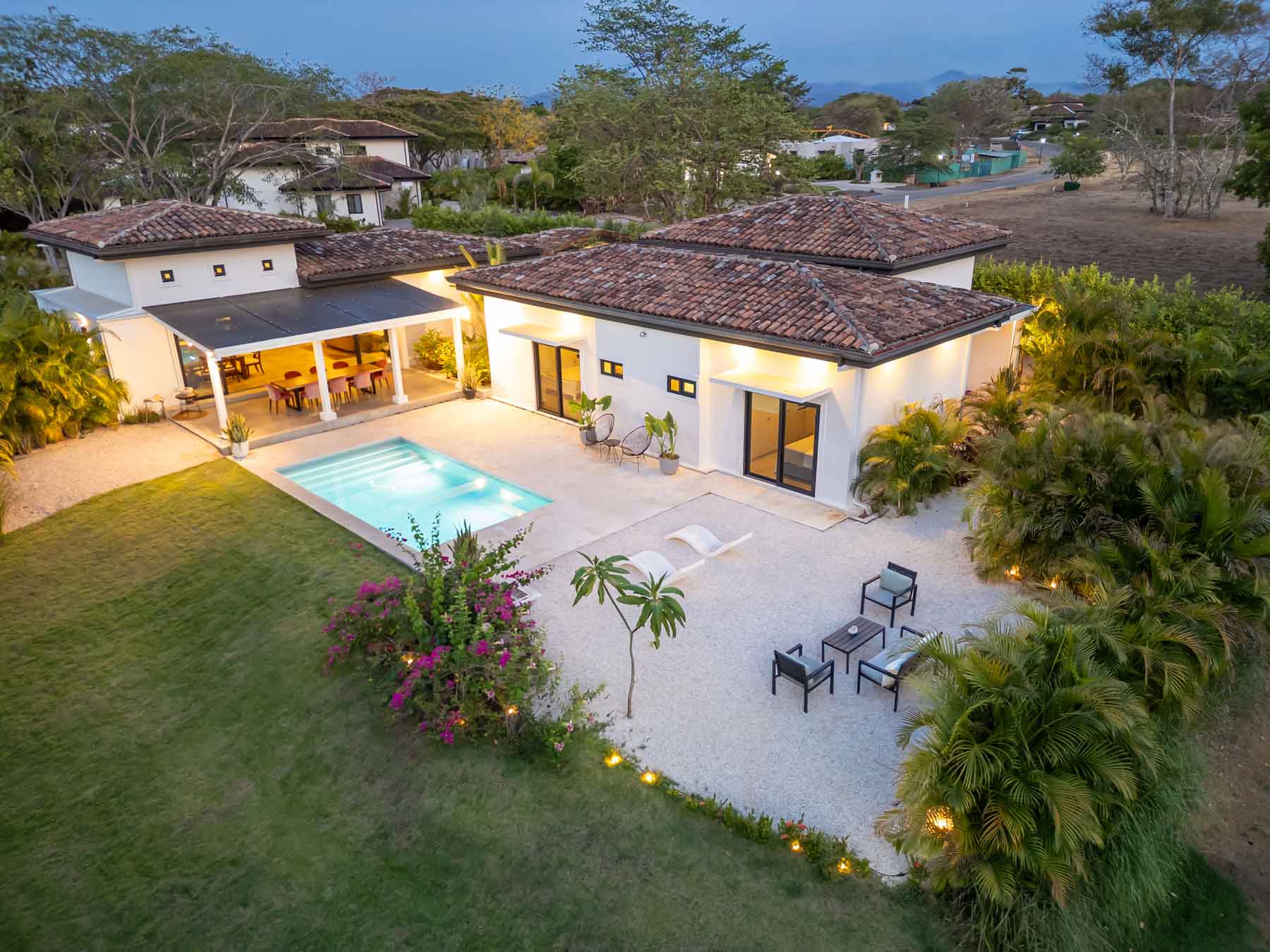
Casa Allamanda from above at dusk

Plan your trip

The practical things nobody tells you until you're standing at the rental car counter.

Getting here

Fly into Liberia, not San José

Daniel Oduber Quirós (LIR) is about ninety minutes away, roughly 75 km, and takes direct flights from a long list of US and Canadian cities. San José is four and a half to five hours by road — only worth it if the fare difference is dramatic or the schedule leaves you no choice.

There is also a small airstrip at Tamarindo, about half an hour away, served by domestic commuter flights.

From the airport to the house

Three options. Rent a car at the airport, which is what most families do. Book a private transfer, which suits a late arrival with tired children. Or hire a driver for the week, which costs less than you'd guess if the group is large.

Tell us your flight numbers and we'll make sure someone is expecting you at the gate.

Renting a car

You'll want one

There's no public transport out here, the community is large, and the good beaches, restaurants and tours are spread across a half-hour radius. A car turns the week from logistics into freedom.

The insurance thing

This is the one that catches people. Costa Rica requires third-party liability insurance on every rental. It cannot be waived, your credit card does not cover it, and it is charged separately at the counter — which is why the price you booked online is never the price you pay. Budget an extra fifteen to twenty-five dollars a day and the surprise disappears.

Collision damage is different: a qualifying credit card can cover it if you bring a proof-of-coverage letter and pay with that card. Agencies vary a lot in how straightforwardly they handle this.

Do you need four-wheel drive?

Not for the highway from Liberia, which is paved the whole way. But the roads immediately around Pinilla include unpaved stretches with potholes, and they get worse in the green season. Higher clearance is worth having. If you're planning Playa Negra or Ostional, it stops being optional — and note that fording a river will void most rental insurance.

Food and shopping

Where to shop

Automercado in Tamarindo, about fifteen minutes away, has the widest range and the highest prices. Super Compro and the smaller supermarkets in town are cheaper. Santa Cruz has the big-value shops. PriceSmart in Liberia is worth a stop on the drive in if you're feeding twelve, but it needs a paid membership and a US Costco card doesn't work there.

The roadside farm stands have the best produce of any of them. Note that supermarkets close early on Sundays.

Cooking, or not

The kitchen is full-sized and opens onto the terrace, so cooking here isn't a chore. If you'd rather not, private chefs and in-villa catering are easy to arrange locally — ask us and we'll point you at people we trust.

When to come

Dry season, mid-December to April

Reliable sun, brown-gold landscape, days around 27–31°C. December, January and Easter week are the busiest and priciest; February and March are the driest; April is the hottest, and inland it can reach the mid-thirties. If this is a first trip and someone in the group would be upset by rain, come now.

Green season, May to November

The dry forest turns emerald almost overnight in May. Typically sunny mornings and a sharp afternoon shower rather than all-day rain, far fewer people, and substantially lower rates. September and October are the wettest — also the best months for the turtle arribadas, and the time some businesses close for maintenance.

May and late November are the sweet spots: green, quiet, and mostly dry.

Seasonal extras

Leatherback nesting runs roughly October to February. Olive ridley arribadas peak August to October. Humpbacks pass through around February–March and again July–October. Surf is good year-round, with bigger swell in the green season.

Money and health

Money and tipping

The colón is the currency but US dollars are accepted almost everywhere, and the ATMs in Tamarindo dispense both. Restaurants add a ten percent service charge and thirteen percent tax by law; another five or ten percent for good service is welcome but not expected. Guides and drivers should be tipped.

Health and safety

There's a medical clinic inside Hacienda Pinilla, walk-in clinics in Tamarindo and Villarreal, pharmacies in Tamarindo and Santa Cruz, and the nearest hospital is in Liberia, about an hour away. Tap water in this area is generally considered safe; plenty of visitors still prefer bottled.

The real hazard here is the ocean, not crime. Rip currents on this coast are serious. Swim where the locals swim, don't let children in the water unsupervised, and see the beach notes on the Hacienda Pinilla page.

Power and phones

120V, 60Hz, US-style plugs — no adapter needed for American devices. Mobile coverage around Tamarindo and Pinilla is good; a tourist eSIM is the simplest option if you want data in the car. The house runs a 1 Gbps fibre line.
What to bring

Worth packing

Reef-safe sunscreen, which is expensive locally. Insect repellent for dusk. A rash guard for each child if anyone is surfing. Hats that survive wind. Water shoes if you want the tide pools at Mansita. Something long-sleeved for a volcano day, which is cooler and wetter than the coast.

Don't bother

Beach towels, hairdryers, a plug adapter, formal clothes. Nowhere here needs a jacket.

Ready when you are

Send us your dates and your flight times and we'll take it from there.